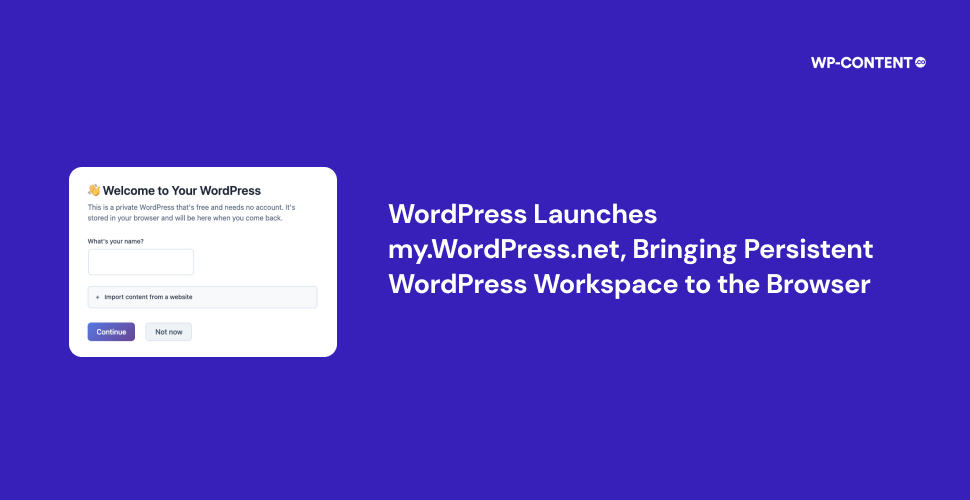



WordPress has introduced my.WordPress.net, a browser-based environment that lets users run WordPress directly in their browser with no sign-up, hosting plan, or domain setup required, and it will remain available when users return, even after closing the tab. The platform is built using WordPress Playground.
Inside the Platform
The announcement says the project changes how people interact with WordPress, shifting it from a service users must set up first to a space they can begin using right away, “ What makes this approach meaningful is not just where WordPress runs, but how it changes the relationship between people and the software itself. By removing the need to sign up or make early decisions about hosting and visibility, my.WordPress.net reframes WordPress as a space you can enter and work within, rather than a service you have to configure before you begin”.
All sites created on my.WordPress.net are private by default, meaning they cannot be publicly accessed.

The websites created also include an App Catalog with several preconfigured tools, including a personal CRM, an RSS reader, and an AI workspace, all of which can be installed in a single click.

The announcement also outlines a few technical details and limitations users should be aware of when using my.WordPress.net. Storage begins at around 100 MB, the data is stored locally and is not uploaded elsewhere, each device maintains its own unique installation, and users are advised to download backups regularly.
The Community Response
The dilemma for the community as the project went live, was how this differed from the already existing Playground.
Abdul Rahman from WP Kitchen voiced, “How is this different from playground?”
Responding to Abdul Rahman, George Stephanis suggested it was designed to provide a persistent environment using local storage, “ I think it’s aimed at persistence via localstorage so it’s not deciding to test a new environment each time you visit?” which the official WordPress account also confirmed.
Matt Medeiros also asked the same question, “is that not what playground already is?”
Fellyph Cintra (Developer Relations Advocate at Automattic) replied to Matt Medeiro, explaining, “No, this version persists by default. You can create your apps and save on your personal playground. The post has more info about it.”
Mtho. voiced, “ Whoever came up with this deserves a beer 🙂 I was tired of Bitnami and Flywheel”
Brad Miller shared a positive reaction to the announcement, “ This might be my favorite thing to see coming from Automattic.”
The landing page also drew criticism as Rafal Tomal commented on X ,“This is why other platforms make fun of WordPress…”
Truebound was also not positive about the UI, “ can you please remove the vibe coded slop ui?”
Matt Mullenweg’s Perspective
Commenting on the launch of my.WordPress.net, Matt Mullenweg said the project represents a broader shift in how people should think about WordPress, “What this means is you need to fundamentally shift how you think about WordPress.”
He added that the underlying WordPress Playground containers allow WordPress environments to be easily modified and reverted when needed, “ These WordPress Playground containers are fully composable and atomic. You can track and roll back any change. Undo for everything. Stop thinking of WordPress as just on a web host and worrying about maintenance and management, and more as a self-contained unit of open source goodness, a fun little package where you own and control the code and data and can run it however you like.”
A future roadmap was provided, which includes plans to add peer-to-peer sync, version control integration, and cloud publishing.
Matt strongly believes that the new approach could dramatically increase the number of WordPress instances running, “ I believe this will take us from millions of WordPresses in the world to billions.”