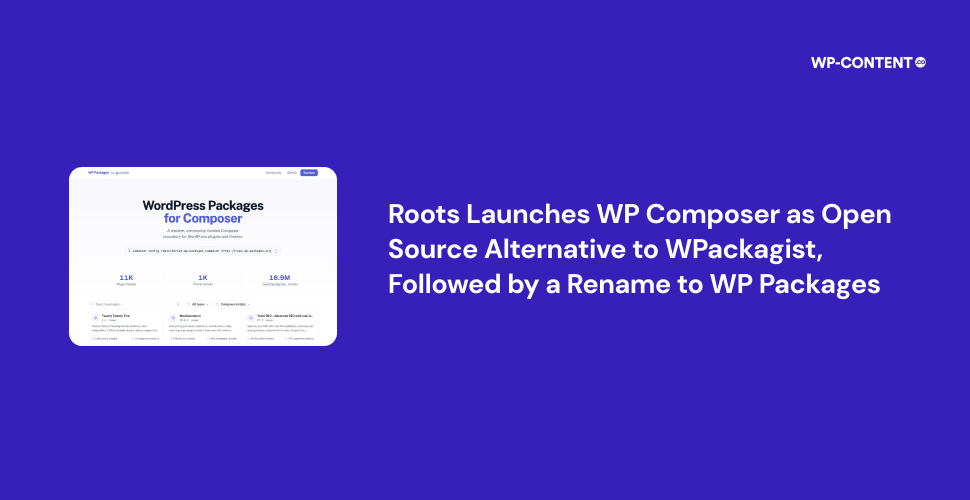



Roots has launched WP Packages (originally called WP Composer), an open source Composer repository for WordPress plugins and themes, just four days after WPackagist was acquired by WP Engine.
Clarifying the Origins and Launch of WP Packages
Ben Word of Roots welcomed the acquisition but expressed concern about private equity ownership of critical tooling, adding that he had been working on a Composer-based project that he now plans to move forward with more quickly, in a post on X:
Joost de Valk also echoed similar concerns, “ I’m glad a company is taking responsibility for critical infrastructure. But it would be better if infrastructure like this wasn’t owned by any one company.”
Four days later, the team at Roots released WP Composer, now called WP Packages, and in the announcement post, described it as, “an independent, community-funded, fully open source Composer repository for WordPress plugins and themes,”
Roots has several other WordPress projects and tooling that they have been building and maintaining since 2011, such as Acron (allows users to use Laravel within WordPress projects) Bedrock ( a WordPress boilerplate with Composer and Git), Sage (WordPress starter theme with Laravel Blade components and templates, Tailwind CSS, and block editor support and Trellis (Ansible-powered LEMP stack for WordPress).
After the launch, Ben Word on X clarified that the work on WP Packages had started last August and not after the recent acquisition of WPackagist, “ We started working on a WPackagist replacement last August, long before any recent attention”.
He also shared a GitHub screenshot indicating that development on the project had started prior to the acquisition.
Ben also clarified that WordPress.com has been one of their sponsors since 2011 and has nto influenced them in their roadmap, “ WP dot com has been a sponsor since 2021, and others, including Pantheon, have supported Roots over the years, with no influence on our roadmap”
Jonathan Bossenger pushed back against concerns about sponsorship influence, noting that WordPress.com’s support for Roots does not affect their independence, much as Automattic sponsors the PHP Foundation.
The WP-Content.co reached out to Ben Word to learn more about the origins of WP Packages and the potential for community-hosted mirrors.
When asked what prompted him to start the project, Word explained, “ We started building this late last year as a natural extension of the Roots ecosystem. Our roots/wordpress package has nearly 20 million downloads, and much of the modern WordPress Composer workflow already runs through Roots tooling.”
We also asked about community concerns that WP Composer mirrors WordPress.org, which is controlled by a private entity, and whether independent, community-hosted mirrors could emerge and remain sustainable, given that initiatives like FAIR struggled to secure sufficient financial and structural support.
On this, Word added, “More than happy to add support for any mirrors, but after all these months nobody has yet to make one which seems odd — just lots of complaining, no action. Open source really isn’t sustainable. We’ve been doing this since 2011 for the love of the game”.
WP Packages vs WPackagist
WP Packages positions itself as an independent, community-funded, and fully open source alternative to WPackagist, which is now owned by WP Engine. While WPackagist operates under a corporate model with less transparency around its infrastructure and governance, WP Packages emphasizes open development, a public roadmap, and community collaboration.
The project also introduces structural improvements in how packages are managed. WP Packages uses clearer naming conventions, wp-plugin/* and wp-theme/*, compared to WPackagist’s wpackagist-plugin/* and wpackagist-theme/*.
WP Packages also includes richer Composer metadata such as plugin and theme authors, descriptions, homepages, and support links, fields that have long been missing in WPackagist. It is also updated far more frequently, with refresh cycles every 5 minutes, whereas WPackagist updates are estimated to occur roughly every 1.5 hours.
On the performance side, WP Packages takes advantage of Composer v2’s metadata-url protocol, which allows Composer to fetch metadata only for the packages required. In contrast, WPackagist relies on an older provider-includes approach that involves downloading large index files before dependencies can be resolved, leading to slower performance. In benchmark tests, WP Packages handled cold resolves (no cache) up to 17× faster, completing tasks in around 0.7 seconds versus 12.3 seconds for 10 plugins, and 1.1 seconds versus 19.0 seconds for 20 plugins.
Everything needed to set up WP Packages, from the code, documentation, and deployment procedure, is publicly available on GitHub, enabling contributions and forking. In contrast, WPackagist’s repository no longer matches its live implementation, creating uncertainty around its open source standing.
Why the Rename from WP Composer to WP Packages
The project was later renamed to WP Packages following feedback from Nils Adermann, co-creator of Composer, who pointed to confusion caused by the original name. Ben Word added that trademark considerations around “Composer” and “Packagist” also played a role in the decision.
As part of the transition, the project’s domain, repository URL, and GitHub repository have been updated to reflect the new name, while package naming conventions remain unchanged and performance and features are unaffected. Existing users can continue using the service, although they may be prompted to migrate.
The Community Response
The official WordPress.org account on X also shared the launch, emphasizing WP Packages’ open source approach and concluding that “open source always wins”:
Reacting to the launch, Seth Rubenstein said, “ Competition is good, will be interesting to watch how this project evolves. Not sure I’m willing to switch quite yet, but I certainly prefer the package naming nomenclature better.”
Describing it as a “solid step forward” for developers, Dipak Gajjar wrote on X:
Calling it a “really good development for everybody in OSS,” James LePage said:
Russell Aaron questioned the sudden emergence of WP Composer, with Bruno Antunes highlighting Roots’ long-standing role in bringing Composer to WordPress, “Come on, Bedrock made WPackagist relevant back in 2013. Without Roots, nobody would even be using Composer with WP today.”