


WordPress co-founder Matt Mullenweg delivered the annual State of the Word address on December 2, 2025, in San Francisco, a milestone year that featured the first-ever live release of a new WordPress version during the event. This keynote also featured the TBPN Podcast, marking yet another notable first for State of the Word.
Mary Hubbard opened the event with the introductory session, highlighting the formation of the WordPress AI team and highlighting that WordPress is all about freedom, as Mary explained, “ But at its core, WordPress is still about freedom. It’s not just software freedom. It’s built to freedom to publish, to build, to learn, and to participate from classrooms to corporation, from Lagos to London. WordPress is powering ideas and unlocking possibilities for millions of people. and it works because it belongs to all of us and those who contribute.”
WordPress’ Market Leadership and Global Reach
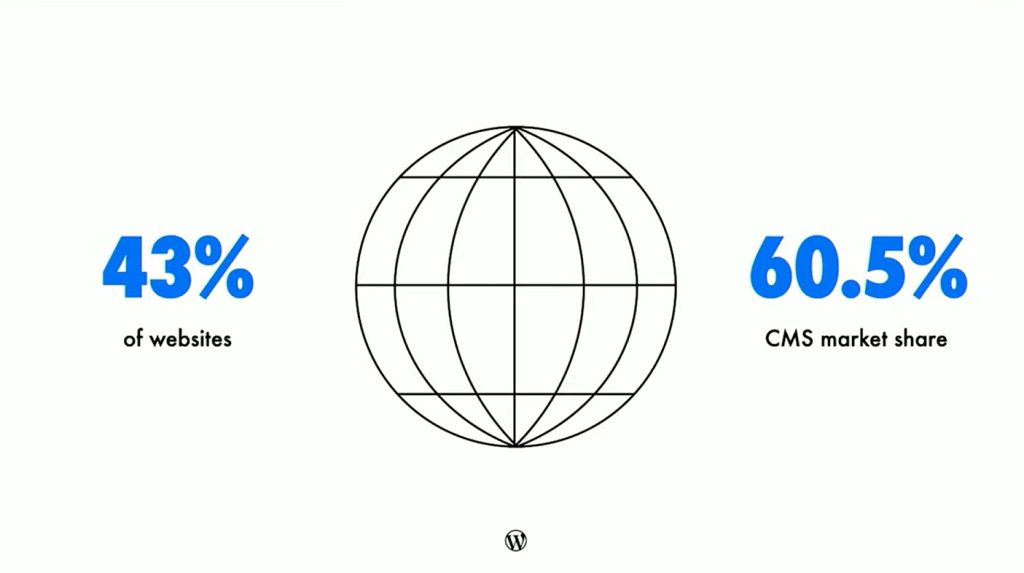
Matt opened the keynote by sharing WordPress’ latest statistics, noting that it continues to dominate the web. WordPress powers 43% of the web and about 60% of the CMS market share, and Shopify, being the second, with 6.8% market share.
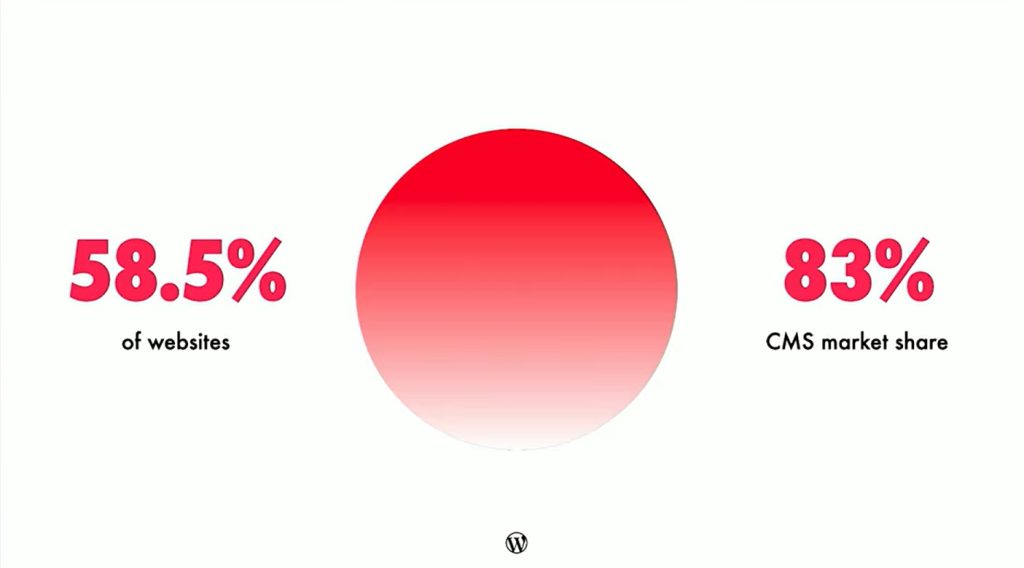
Building on these numbers, Matt moved on to address people’s question, “you know, some people ask like, is 43.3% where we’re gonna hit”, to which he stated “ I do think that there have been some headwinds..”, following which he pulled market statistics from Japan, where WordPress powers 58.5% of websites and has 80% CMS market share. Compared to last year, the CMS market share in Japan has seen a decline by 3 percent, from 83 to 80.
The keynote shifted to address a global shift, where English (44%) still remains as the most used language, but Japanese (5.82%) is now the second most popular language, followed by Spanish (5.8%), German (5.51%), Brazilian Portuguese (4.10%), and Other ( 34.77%). Comparing this to last year’s statistics, the difference is that Japanese has moved from fourth to the second most used language.
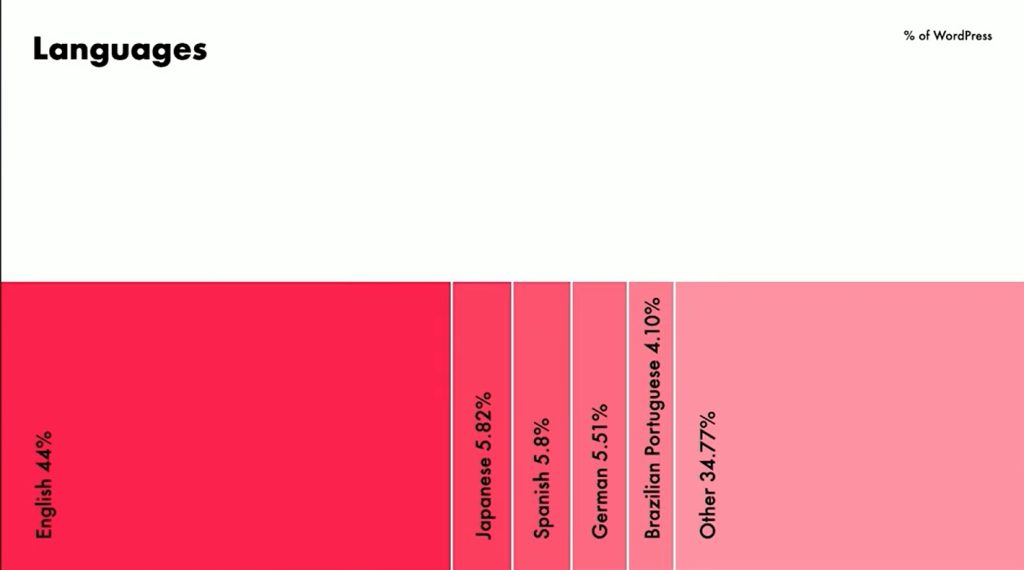
Continuing on the topic of language trends, 2025 is also the first year in which more than 56% of WordPress websites are in languages other than English. Also, WordPress is now at 49.4% of the top 1000 websites in the world, which is a 2.3% rise from the previous year.
From platform usage, Matt transitioned to ecosystem growth. The Plugin directory now has over 60,000 plugins, which is more than 68 percent compared to last year, and the plugin downloads are expected to hit 2.1 billion downloads by the end of the year. Over 1500 themes have been released, and there are over 14000 themes in total. There has also been a 40% increase in the adoption of block themes, and there are over 1000 block themes now
Continuing with release-specific updates, WordPress 6.8 Cecil saw 79.5 million downloads since April, an increase of 13% compared to last year. Following this, Matt Mullenweg, along with several WordPress leads, released WordPress 6.9, “Gene”. The release has over 900 contributors, out of which 230 were first item contributors.
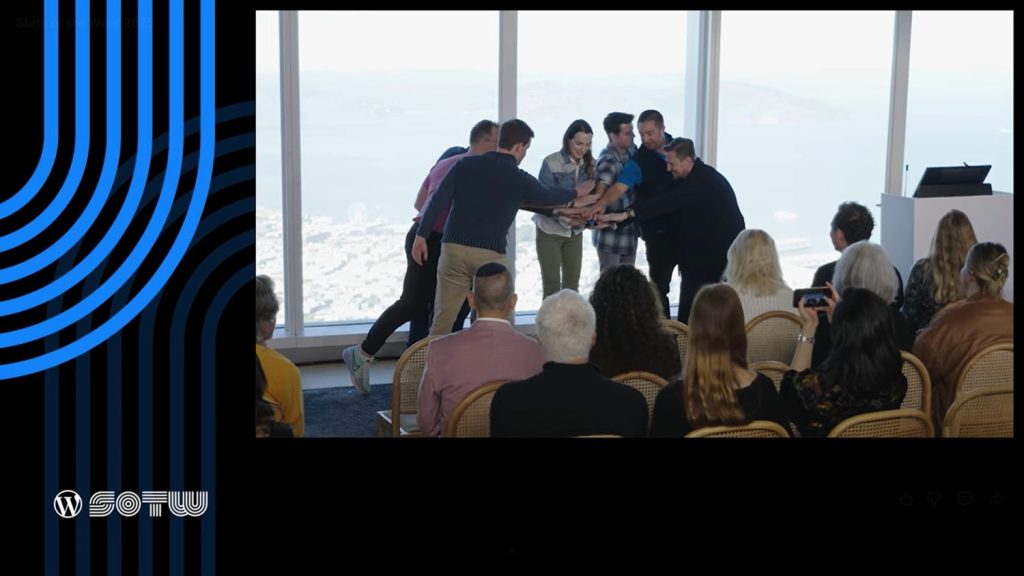
This is also the first time that a WordPress version was released live during the State of the Word.
Matt stated the approach that WordPress is taking with AI as, “ Empowering, not replacing people”. To improve the use of AI and WordPress, one of the focus areas for 2026 will be benchmarks and evals as stated, “ A big area of investment that we’re going to do in 2026 is creating some benchmarks and evals that all the AI models can test themselves against for doing WordPress task…..”
The keynote also highlighted several AI tools making impacts in the ecosystems such as Hostinger’s Kodee, Elementor’s AI Co-Pilot, Jetpack AI, usage of AI by Yoast for keyword clustering, the AI site builder at WordPress.com, AI Engine, and AI Power. The benefit of AI in automating plugin and theme reviews, translations was also touched up on. Finally, the Telex project was also discussed.
Empowering the Next Generation Through Education
At this point, Mary Hubbard took over to delve into the Education initiatives aimed at supporting the next generations. This year, there were 81 WordCamps in 39 countries, with over 5200 organisers and over 100k attendees. By the end of this year, total WordCamps will be 97, and the number of events has grown by over a third this year.
Learn.WordPress.org has served over 1.5 billion users this year, and the engagement time per user has also increased, as stated by Mary Hubbard, “ After WordCamp US, the average engagement time per user increased by 32%, which tells us that students and contributors are spending real time learning, not just passing through.”
Building on this, Mary Hubbard highlighted that more people are discovering WordPress, but many arrive still unsure how to navigate the ecosystem. That’s why education is important, as highlighted by Mary, “ Users are landing on WordPress.org at high volumes, and they are comparing platforms, they are looking for documentation, they are searching for a way to get into the ecosystem, and the path is not always clear. And this is why education matters. Learn WordPress, WPCC, WordPress Credits our student organization, they are giving people a structured way to go from curious visitor to confident builder.”
The focus now is closing the gap between discovery and participation, helping new users move from awareness to skill-building and eventually contribution as stated, “And once people reach the right resources, they stay, and they learn and the opportunity now is to close the gap between discovery and participation. So the work we are doing now in education is positioning WordPress to guide new users from awareness to skill building to contribution.”
Attention was also given to the first WordPress Campus Connect in Latin America, organized at the University of Fidélitas.
Community Achievements
One of the most powerful things emerging this year is how multi-generational WordPress has become, and also how Wapuu has become a global community-driven mascot. WordPress.org is also planning for a Wapuu mascot museum for next year, as stated by Matt, “ we’re actually gonna bring on like a cool little Wapuu museum on wordpress.org that we’re gonna try to spin up next year to just document all the different ones all around the world.”
2025 WordPress Youth Day, Nicaragua was a breakthrough success as attendance tripled compared to last year. This year, 75 young people aged 8–20 years old showed up, whereas in 2024, the attendees were only 30.
WordPress 6.9 Exploration
Matias Ventura took over the center stage virtually to showcase the new features and changes in WordPress 6.9, like the Notes feature, the new math block, and so on.
Plugin Review, WordPress Playground & Studio
Matt addressed how AI has sped up the review process and compared to 2024, the plugin repository is seeing over 100 more submissions every week, and the plugin review queue is now under seven days.
Moving forward, he highlighted how WordPress 6.9 has improved the WordPress importer, with improvements to the author mapping. With regard to WordPress playground, there is a new file browser and blueprint gallery. Playground CLI has introduced new features for developers, such as Xdebug support, MySQL emulation, and so on. Blueprints can now load files from Git repositories, even the private ones.
Also, Matt covered the new safe-release features, like a 24-hour auto-update delay (with future staged rollouts), which make plugin updates far safer for millions of WordPress sites.
Panel Discussion on AI and WordPress: Path Forward
The panel consisted of James LePage, Felix Arntz, and Jeff Paul. The discussion explains how WordPress’s new AI tools, like the Abilities API, WP AI Client, MCP integration, and AI Experiments, are making development faster and more open, and setting the stage for WordPress 7.0.
Q&A
There was also a Q&A session where Matt answered questions related to Cloudflare, the future of collaborative commenting introduced in WordPress 6.9, the role of domain names, AI agents, and so on.
The event was live-streamed and is available on the WordPress YouTube channel.