


The WordPress AI Team has outlined plans to make WordPress natively compatible with AI agents, allowing users to connect their preferred agents to their websites without having to install and configure the MCP Adapter plugin or manually manage authentication. The proposal published by Jason Adams outlines the work toward introducing native support for AI agent connectivity in WordPress 7.3.
The proposed work covers four areas: the MCP Adapter, Abilities, OAuth authentication, and the end-to-end user experience. The WordPress 7.2 release cycle will be used to establish the foundations for these developments.
The four areas of focus
The proposal builds on existing efforts to bring AI-powered site management to WordPress. Adams points to Jetpack, Elementor, and WPVibe as examples of products responding to interest in using agents to manage websites.
He sees this as more than another way of accessing WordPress, suggesting that agents could expand what users are able to accomplish with their sites, “Commercialism aside, it’s amazing to think of users being able to build the most incredible versions of their WordPress worlds because their agents raise the bar in what they can achieve. It’s not just another surface by which to control WordPress, it opens another level of possibilities for those users”.
One of the challenges the proposal seeks to address is how users currently connect agents to WordPress. Although tools such as WP-CLI, the REST API, and filesystem access already give agents ways to work with the platform, setting them up can involve local access and technical configuration.
The MCP Adapter offers another route, but it also introduces several steps for site owners, including plugin installation, configuring available Abilities, and setting up authentication with Application Passwords.
Adams believes this process needs to change before agent connectivity can serve a wider range of WordPress users. He describes the existing setup as “not a scalable approach for the broad WordPress user base.”
The proposed development would build on MCP, which Adams identifies as the open standard for allowing agents to communicate with external systems. Rather than relying on the current setup alone, the team wants to make the MCP Adapter more reliable, secure, and easier to use.
The team is also moving forward to make MCP a core part of the WordPress experience after Matt Mullenweg approved moving ahead with the initiative, “Matt has approved moving forward with making MCP a de facto part of the WordPress experience, recognizing the growing adoption of AI agents and the importance of making WordPress accessible through agent-driven workflows.”
Another consideration is what agents can actually do after gaining access to a site. The proposal calls for establishing a core set of Abilities covering everyday site management tasks. Development of these capabilities would continue through the AI and/or MCP Adapter plugins, while the team also investigates whether some foundational Abilities could be ready for WordPress 7.2 before its beta period ends.
The way users grant agents access is also set to change. Under the proposed OAuth approach, site owners would authorize agents directly instead of having to create and distribute Application Passwords themselves. The initial work will involve defining how authorization should operate, the architecture required, and the security measures needed before implementation is considered.
The potential use of OAuth is not limited to MCP connections. Adams also identifies the REST API as another area that could benefit from the work. WordPress 7.2’s upcoming Secrets API may provide a way to handle the tokens involved more securely, and the proposal calls for coordinating the authentication work with the broader Core team.
These changes are intended to make connecting an agent feel like a normal authorization process rather than a technical setup exercise. Adams illustrates this with a user asking a personal agent to help with a WordPress website. Instead of requiring the user to configure integrations or supply credentials manually, the agent would recognize the platform and direct the user to an authorization link.
Once the user signs in, the agent would confirm access by saying, “I’m in! How can I help you with your site?”
The proposal also considers what happens after that initial connection. Users would need a straightforward way to oversee the access they have granted, including controlling permissions and revoking them when necessary. The team plans to use prototypes to test the experience and identify problems across the different stages, from the agent’s initial discovery of a site to its subsequent interactions with WordPress.
The security work will include reviews and audits of the new ways external agents could interact with WordPress. Adams also mentions specialized security-focused AI models as part of the proposed review process.
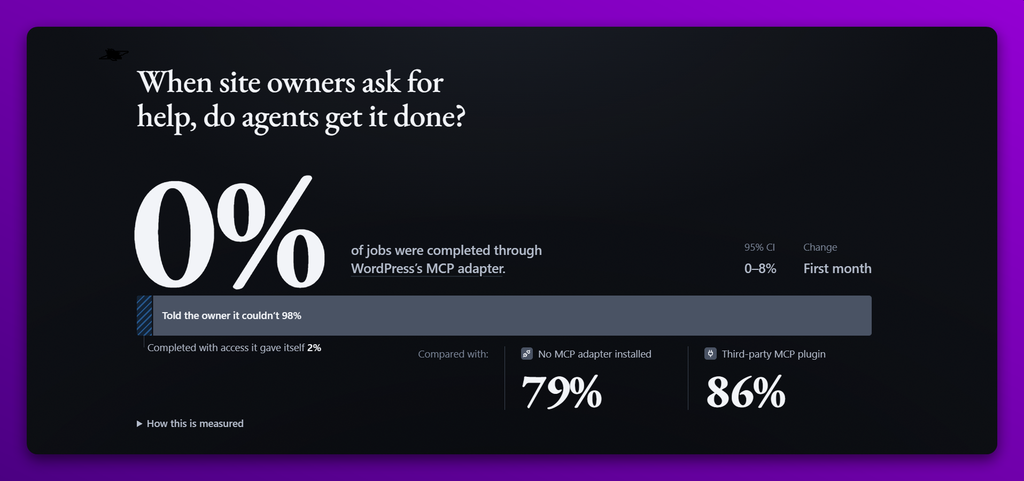
Andy Peatling’s test finds limitations in WordPress’s MCP Adapter
He recently tested two AI agents across 21 WordPress tasks and found that none of the 42 runs completed successfully with WordPress’s MCP Adapter installed, compared with 33 completions without it. The test found that the MCP adapter’s limited registered abilities restricted the agents’ ability to make changes, while the built-in WordPress API enabled them to complete 33 of 42 runs.
Delivering the work will involve coordination across contributors and the Core team. The proposal calls for individual leads to take responsibility for each development area, set milestones, and coordinate implementation and testing. They will also share updates and raise blockers during the weekly AI contributor meetings.
Core Committers are being invited to work alongside these leads from the beginning of development. Bringing them into the process early is intended to help identify architectural and compatibility issues, as well as security concerns, before proposed changes reach the merging stage.
Contributors interested in the development can volunteer through the #core-ai Slack channel or join the weekly AI contributor meeting.