


Matt Mullenweg on the #core-committers Slack channel posted a prolonged series of messages in response to a Trac ticket involving Akismet. What began as a discussion about that ticket quickly broadened into a wider critique of how the WordPress project operates
Over the course of the discussion, he questioned release processes, contribution workflows, and what he described as overcomplicated decision-making that is slowing down shipping across core.
The Akismet Trac Ticket- Where it began
Mullenweg said he encountered the conversation regarding the Aksimet ticket “on accident” after gaining internet access via Starlink on a return leg from Mumbai, which allowed him to review direct messages and notifications.
“Again to return to me being here on accident… the plane had Starlink, and so I was able to catch up with all my DMs here, and happened to see this ping from ten days ago,” he wrote, referring to a message that had gone without his response for over a week.
The ping was regarding a discussion about a Trac ticket related to Akismet created by an Automattic employee, which proposed registering Akismet Anti-Spam as a connector type in the AI Connectors settings screen. The ticket was also highlighted in the #7.0 Release Leads channel.
In the thread, Earle Davies raised concerns about how the ticket had been handled, questioning the gap between WordPress’s open contribution model and the reality of how contributions are processed.
“When people complain about WP issues a common response I see is ‘WP is open source, anyone can contribute’. Sure, anyone can contribute. But that doesn’t mean their issue/PR won’t sit there for years before being merged,” the contributor wrote.
They contrasted that with the handling of the Akismet-related ticket, alleging that it had been created and merged during a release candidate phase without public discussion.
“Meanwhile a trac item got created by an a8c employee and merged during an RC with 0 public discussion,” the message said.
She further claimed that internal discussions between Automattic employees played a role in the decision-making process.
“The rationale is the trac ticket was discussed in private with another a8c employee… So 3 a8c employees pushed through a trac ticket to give special treatment to an a8c product (Akismet),” they wrote, calling the situation “obviously inappropriate to be in core.”
They also called for the change to be reverted and for greater transparency in decision-making. “This ticket should be reverted ASAP… This needs to be said out loud and publicly,” the contributor added, while raising concerns about what they described as “opaque and not public” conversations during the 7.0 release cycle.
The ticket was committed fast, after 36 minutes of opening, however, Peter Wilson, a core-committer, submitted a pull request on the same day to revert the commit, highlighting what Matt had said earlier about how Akismet should register its keys to be on the connectors screen, “ Akismet (and other plugins) should register their keys to be on this page, so instead of users having to go around a bunch of different menu areas there is one place for all of this. “
Wilson also said, “ Akismet can easily be removed from an install and replaced by another anti-spam solution. Some of which also require an API key.”
David Baumwald, another core-commiter also supported the revert pull request saying, “ Agree that this should be reverted. Akismet should register its connector via wp_connectors_init.”
John Blackbourn highlighted that there was no public discussion, no approval for the PR, and that the change was committed during the release candidate phase, “ but it is inappropriate to make this sort of change during RC, especially within such a short period of time and with no public discussion.”
The revet was committed on April 6, but now Matt Mullenweg has asked the core-commiters to add Akismet to the Conenctors screen, despite what he said earlier, ”I did say that, and have changed my mind and we’re doing this.”
On Slack, Matt also responded to Aaron Jorbin’s proposal for guidelines before additional connectors are added, saying, “ You are living in fantasy land if you think that is remotely possible”
Further conversations have been moved to 7.1 cycle, as said by Matt, “ Let’s and pick up the debate for 7.1 in Slack and other places where it’s easier to communicate.”
The internal factors behind the slowdown
Once he reviewed the trac ticket, the postings began on Slack where he pinged multiple core-commiters to kick off the discussion.
“I am very sad at the state we’ve gotten ourselves in on WordPress and WordPress.org,”
– Matt Mullenweg
Straightway, he addressed the fact that the discussion had continued for more than ten days and expressed concern about how long the discussion might have continued otherwise, “ I shudder to think how much longer that could have gone on! I am in awe of the brainpower and talent of the people in that thread, I think it’s funny how I and we can keep being so smart but so dumb at the same time, and I think we keep repeating these patterns, and I’m also incredibly sad.”
“I am very sad at the state we’ve gotten ourselves in on WordPress and WordPress.org,” he added, framing the situation as part of a broader pattern.
Mullenweg pointed to WordPress’s early reputation and the criticism it faced around its technology, governance model, and commercial viability, contrasting that with its long period of sustained growth, “ We took something that with “bad” technology, no ability for people to make money on because it’s open source, unsophisticated developers because they’re not using an object-oriented approach, and has “no governance”, and “businesses and enterprises will never adopt” and is “insecure” and kicked the butt of all the people say by growing faster than them in an unstoppable fashion even as our success attracted billion of dollars of counter-investment and counter-advertising
He emphasized that this growth was not short-lived, but sustained over a long period.
“FOR 19 STRAIGHT YEARS… that’s crazy.”
Mullenweg also added that three years on, WordPress continues to operate in largely the same way, yet some within the project attribute its slowdown to his public comments about WP Engine in September 2024.
He rejected that explanation, instead pointing to internal factors.
“We are not being killed by competition, I believe we have done this to ourselves,” he said, adding that the situation was not intentional. “We didn’t do it maliciously, we did it by blindly following rules and ideals to a point when they became iatrogenic.”
He pointed to reluctance around private or real-time discussions, suggesting that even attempts to quickly settle disagreements can be slowed by expectations around participation and notice.
We need to stop following these stupid policies as good open source practices, when they are keeping us from shipping more open source to the world
– Matt Mullenweg
He argued that some of these norms, while rooted in open source principles, may now be counterproductive, “ we need to stop following these stupid policies as good open source practices, when they are keeping us from shipping more open source to the world”
Criticizes communication norms and decision-making
Mullenweg criticized what he described as the project’s communication practices, arguing that an emphasis on fully open and inclusive participation can make it difficult to resolve issues efficiently.
He pointed to resistance around real-time or private discussions, suggesting that even attempts to quickly settle disagreements are often slowed by expectations around coordination and advance notice, “ but we can’t call each other on the phone, because that would be a, GASP, private conversation, that not everyone can participate in, and even if we came in here and used a Slack huddle or something anyone would join, if we did it same day to resolve an argument, someone would complain there wasn’t enough heads up, and we need to do it twice so APAC people can join”
Mullenweg argued that these norms, while rooted in open source principles, may now be counterproductive, “ we need to stop following these stupid policies as good open source practices, when they are keeping us from shipping more open source to the world”
He questioned how these practices became entrenched, describing the situation as one where contributors are “operating at a level of collective delusion,” and calling for a broader reassessment. “Zoom out, do you even want WordPress to be successful?” he added.
On project structure, consensus, and decision-making
Mullenweg continued what he described as deeper structural issues within the project, including increasing complexity in contribution workflows and decision-making.
He described the original ticket as “a microcosm” of broader problems, stating that the project has “undone everything that made us successful, “ it is a microcosm of all the ways we’ve undone everything that made us successful, made contribution incredibly painful, and end up shipping boring or mediocre crap”
He also argued that an overemphasis on consensus is limiting innovation, noting that many of WordPress’s past successes were not universally agreed upon at the time.
Mullenweg also pointed to the time spent debating decisions, suggesting it may be affecting release quality, “When we spend too many hours… fighting about everything, it’s keeping you from moving on,” he said, adding that this may be “part of the reason releases have been boring for years.”
He further highlighted operational concerns, including the volume of unresolved issues. “There are 8,094 tickets, and that’s not okay,” he said, questioning why the backlog has not been treated as a priority.
He also criticized what he described as misaligned priorities, stating that contributors are spending time on “trivial things that literally don’t matter”.
Governance, delegation, and leadership concerns
Reflecting on governance and leadership, Mullenweg suggested that efforts to decentralize decision-making may have contributed to the current state of the project.
He said that, in response to criticism over the years, he had stepped back and distributed responsibility more broadly across teams and committees.
“just like I need to stop letting .org people make me think my contributions aren’t good…I created all the structures and committees and delegated power and decision making very far and wide,” he said, adding that he had come to believe those criticisms at the time.
However, he indicated that this approach may not have had the intended outcome. “While I’ve been gone the wheels have fallen off,” he said.
He added that delegation remains necessary, but should be paired with accountability and a focus on outcomes. “I cannot do everything, I have to be able to give others the ability to do things without being blocked,” he said, adding, “We need to judge on results, not the precautionary principle.”
The delay in shipping new features
He also criticized the current state of certain features in core, referring to the AI connectors screen as an example of something not functioning as intended. “THIS FEATURE DOESN’T EVEN WORK AS IT’S SUPPOSED TO,”
He also contrasted the pace of external platforms with WordPress core, pointing to Cloudflare launching EmDash as an example, saying they can ship “the entire functionality of WordPress, and then some, in 2 months.”
But here, even relatively small interface work can take far longer, saying “but it takes us so freaking long as professional web developers to ship a blank page with 3-4 buttons on it.”
Akismet, Automattic, and contribution imbalance
Matt Mullenweg defended the inclusion of Akismet in core, pushing back against criticism raised in the discussion and emphasizing its long-standing role in the ecosystem.
“Akismet has been in core for 20 years! And the world hasn’t ended!” he said, adding that the service has blocked “569,403,129,437 spams for WordPress sites, almost entirely for free.”
We should be embarrassed how little we recognize these contributions and instead attack them all the time
– Matt Mullenweg
He argued that contributions of that scale are often under-recognized, while drawing disproportionate scrutiny. “We should be embarrassed how little we recognize these contributions and instead attack them all the time,” he said.
Mullenweg also pointed to what he described as an imbalance in how different companies are treated within the project, contrasting Automattic’s role with others he said contribute far less.
“It is pathological that we keep attacking me and Automattic who have by any measure given the most,” he said.
He added that criticism is often directed at Automattic even in contexts where other companies are involved but contribute little. “Underneath the logos of two companies that have given almost nothing to the project… that’s f’d up,” he said, adding that while Google has contributed in the past, “they’ve stopped, and we give Automattic more grief and I haven’t seen anyone complain about Google.”
Mary Hubbard also joined the discussion by pushing back on the idea that Automattic was being treated unfairly in context of contributions, stating that “Yes, Automattic has a right to compete, just like every other company,” but Mullenweg pushed back on that framing, responding that “stop saying that, it’s playing into the gaslighting,”
He also pointed to challenges in securing support from newer industry players, noting, “we can’t even get Anthropic to add us to their program for open source projects,” despite WordPress being “one of the most used and highest impact open source projects in the world.”
He also expressed frustration about his role in shaping product direction, saying he feels constrained in his ability to contribute.
“You’re not allowing me to lead and bring product vision! Talents I’m trying to donate NON-SPONSORED because it is on top of a very busy job, talents that literally have generated billions in value.”
Theme review and AI rules
Mullenweg also pointed to the theme review process as another example of how existing rules may be discouraging contributors and limiting what gets shipped.
He highlighted a specific case involving the Twombly theme by Nick Hamze, questioning why it was rejected despite meeting most guidelines. “Did we have to reject his beautiful and otherwise following every guideline theme, because it had an AI-generated image?” he said, calling the rule itself outdated given how widely AI is now used.
But earlier this year, the Themes Team had agreed to move forward with allowing AI-generated images if they are clearly disclosed in the README file. Carolina Nymark also pointed this out, “ That is not entirely accurate. 12 months ago, 6 months ago, a theme would have been rejected for use of AI generated images. It was changed in January.”
Matt also left a comment on Nick Hamze theme ticket saying, “No, you’ve driven him to the point of insanity with this and he’s probably not coming back.”
“Which is a dumb rule in the first place in 2026,” he added, arguing that the project is still acting as if it needs to decide whether AI will matter. At the same time, he pointed to the Ollie theme also being rejected in 2023 also.
He also questioned whether established products would be able to pass through the current review process, asking, “If Elementor were submitted today, would it be accepted?”
Critiquing the WordPress.org website
Mullenweg also raised concerns about WordPress.org, saying that “the most important parts of WordPress.org have atrophied or sometimes even been hidden.”
He pointed to the WordPress News page as an example of what he sees as poor execution, describing it as “ridiculous designs” with large headers and little meaningful content below.
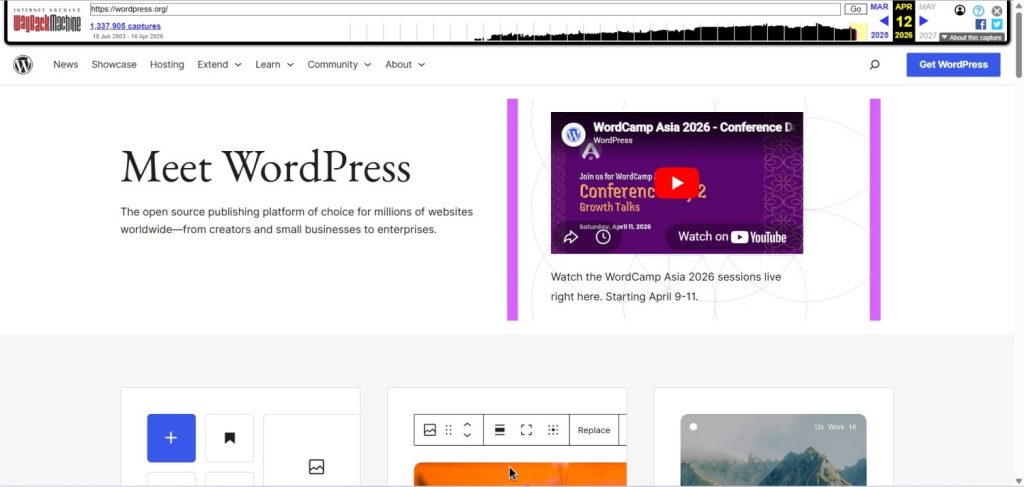
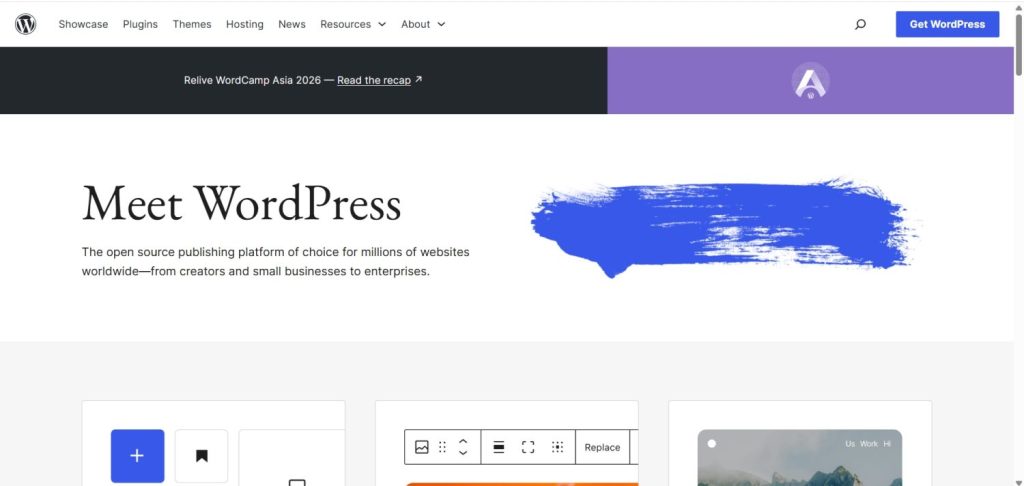
Continuing, he also criticised the current WordPress.org navigation priorities, saying that key links are being deprioritised. He argued that Showcase, Plugins, and Themes should be the primary items in the main menu, and expressed frustration that “News” appears first on the homepage instead.
Below is how the page looked when the discussions happened.
Now, after the revision, the primary items in the menu have been reordered.
He said he didn’t think anyone in the core-commiters would allow a design like the WordPress.org, “ I don’t think anyone here would allow a design like /news to ship in core”
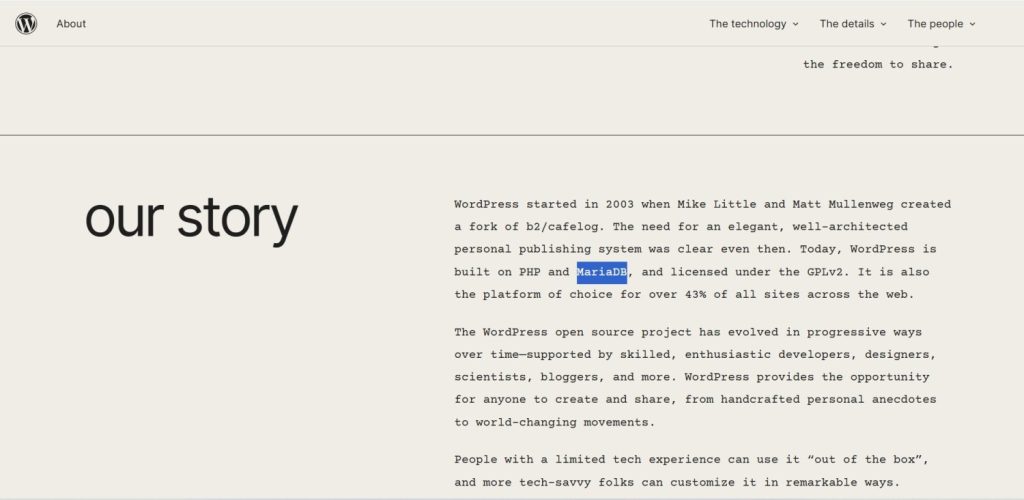
The About Page was also highlighted, where it wasn’t properly updated to show the shift to MariaDB.
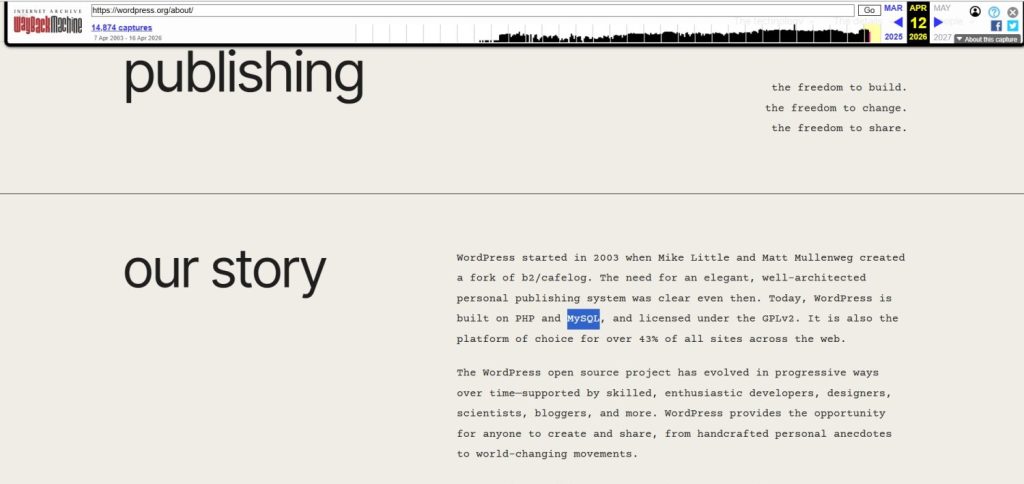
The page below is updated now.
Reflections on missed opportunities
He also reflected on past missed opportunities, saying that despite previous disagreements, he now wishes they had followed the lead of Joost de Valk when he tried to help improve the project. He added that he did not do enough to support him at the time, and credited him with strong product sense that could have driven meaningful improvements.
Joost de Valk was appointed as the Marketing & Communications Lead of WordPress back in 2019, but he later stepped down from the role after five months.
Matt Mullenweg had earlier banned Joost de Valk from WordPress.org last year, after Joost described Matt as as a BDFL (Benevolent Dictator For Life) and called for Breaking the Status Quo of the WordPress world.
The Responses
David Baumwald, a core committer, described the situation as “bureaucratic ‘process creep’,” adding that “something made to please everyone will end up thrilling no one.”
Tammie Lister raised concerns about increasing process and review workload in WordPress, suggesting the project should make better use of modern tools like AI rather than relying on more manual triage.
Anne McCarthy highlighted an AI-powered tool, recommending the use of CodeVitals developed by Riad Benguella, to help analyze items that need to be closed or reviewed. She said she uses it regularly as part of her workflow and finds it effective for managing review work.
Jeff Chandler on X said, “Holy moly. I feel for anyone who got Matt Bombed today. It appears a sort of unraveling happened today.”
Matt replied to him saying, “The only bomb is what we’ve been doing the last few years. And yes it’s my fault, and I’m going to fix it.”
Katie Keith on X voiced, “ While the tone has upset people, I think a strong leader with a clear vision who cuts through red tape and actually ships things is exactly what WordPress (and WooCommerce) needs to stay relevant. It’s not like WordPress has ever been a full democracy anyway. “
https://x.com/BlakeWhittle7/status/2044054795246248042Blake Whittle backed Mullenweg’s position, arguing that WordPress needs to prioritize execution over consensus.
Coen Jacobs disagreed with this framing, saying the issues being discussed were not new and had been present “on and off for at least a couple years, if not longer.”
Duane Storey argued that the current state of WordPress had been shaped over time rather than emerging suddenly, “ WordPress didn’t just randomly end up in this state, it’s been actively driven here.” He also argued that many of the issues facing WordPress developed under Matt Mullenweg’s leadership, saying “most of the problems in the space happened on Matt’s watch” and “he owns that, 100%.” He also pointed out that Mullenweg has served as a release lead on several major versions in recent years, adding that his “inability to see his contribution to any of this is part of the problem.”
Sé Reed echoed similar concerns around leadership, pointing to Mullenweg’s long-standing role in release leadership.