

The Admin Bar has published its State of the WordPress Agency 2026 report, based on a survey of 622 agency owners and freelancers across 51 countries, with an average of 12.8 years of experience.
The findings highlight key trends shaping WordPress agencies, with most relying on word-of-mouth for new business, recurring revenue playing a significant role in profitability, and burnout emerging as a notable challenge for many.
Agency Size, Work Structure, and Burnout
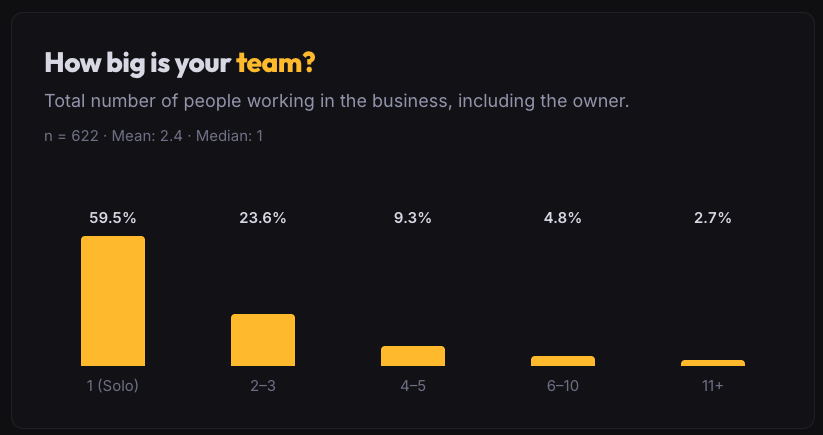
Most WordPress agencies surveyed operate with small teams, with 59.5% identifying as solo operators and a further 23.6% reporting teams of two to three people. Only a small share of respondents indicated having larger teams. The respondents reported running their WordPress business as a full-time venture, with 80.2% identifying it as their primary source of income, while 19.8% described it as a side hustle.
The survey found that women were more than twice as likely as men to identify burnout as their primary barrier to growth, with 16.9% of women citing it compared to 8.1% of men.
Revenue, Pricing, and Profitability Trends
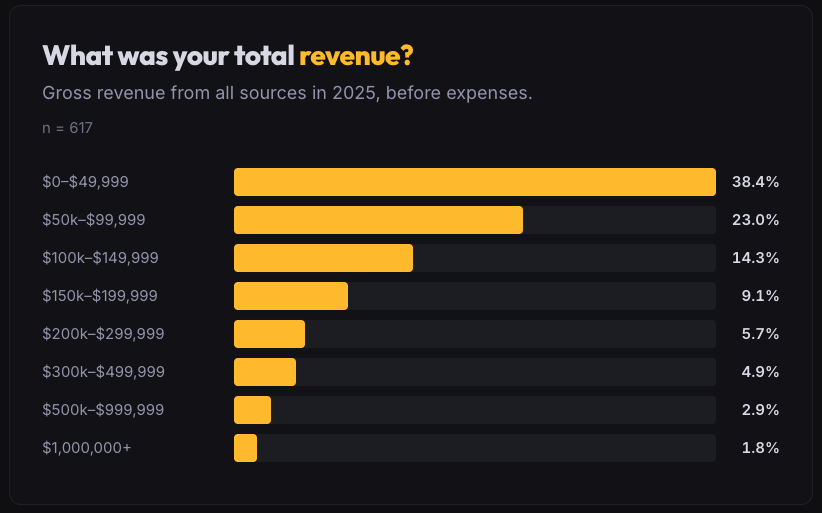
The survey found that most agencies operated in lower revenue brackets in 2025, with 38.4% earning under $50,000 and 23.0% between $50,000 and $99,999, while only a small share reported revenues above $500,000.
Owner compensation followed a similar pattern, with 31.7% reporting earnings below $20,000 and 30.7% between $20,000 and $49,999, while fewer respondents reported higher income levels.
Project pricing was concentrated in the mid-range, with 37.7% of agencies charging between $2,500 and $4,999, followed by 24.4% in the $5,000 to $9,999 range, with higher price points less common.
There’s also a shift in profitability at higher project price levels, with agencies charging $5,000 or more reporting stronger profitability rates than those below that threshold.
Overall, 40.9% of respondents described their business as consistently profitable in 2025, while 33.2% reported operating with thin margins.
What’s Driving Growth and What’s Holding Agencies Back
Another major highlight is the role of recurring revenue, with the survey showing that agencies without it were far more likely to be unprofitable, while those with at least 25% recurring income reported significantly lower rates of losses.
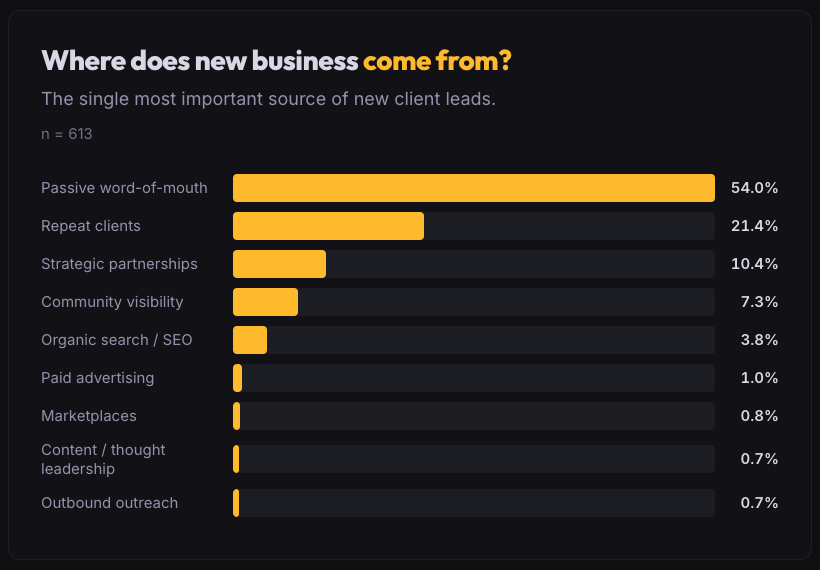
Now, when it comes to how agencies acquire new business, passive word-of-mouth is cited as the primary source of leads, followed by repeat clients and strategic partnerships, while other channels accounted for a smaller share.
Respondents pointed to a range of factors limiting agency growth, with finding qualified leads cited most often, followed by capacity and time constraints and personal burnout.
The report also links burnout to revenue levels, with agencies in lower revenue brackets more likely to cite it as their primary barrier. Among those earning under $50,000, 15.1% reported burnout as their top challenge, compared to 3.3% among agencies generating $200,000 or more.
Accessibility was reported as a less commonly offered service, with only about one in four agencies providing it. Those that do, however, showed stronger outcomes, including a higher share reaching $200,000 or more in revenue and a lower share reporting declines in 2025 compared to agencies that do not offer accessibility.
Tools, Performance, and Outlook for 2026
When it comes to tools and frameworks, non-block third-party builders were the most commonly used, cited by 58.3% of respondents. This was followed by block-based third-party solutions at 27.8%, while 9.7% reported using default WordPress tools such as Gutenberg or full site editing.
Responses on business performance show that growth was more common than decline in 2025, with 11.8% reporting significant growth and 36.6% moderate growth, while 32.3% said performance remained about the same and a smaller share reported declines.
Looking ahead, sentiment for 2026 leans positive, with 18.5% of respondents describing themselves as very optimistic and 41.0% cautiously optimistic, while others expressed neutral or uncertain outlooks.
On the impact of AI, most respondents reported a positive effect on their business, with 31.4% describing it as significantly positive and 41.4% somewhat positive, while a smaller share reported neutral or negative impacts.