

The WP Open Community Collective (WPOCC) has published its State of the Community 2026 survey, presenting the results of an independent, anonymous survey of people involved with, building on, contributing to, or interested in the WordPress open source project.
Conducted between May 27 and July 17, 2026, the survey received 431 responses to 231 questions. The WPOCC has also made the underlying data, survey questions, methodology, and information about the survey’s limitations publicly available on GitHub under Creative Commons licenses.
The report highlights 11 findings related to areas including attitudes toward WordPress and open source, community participation, governance and leadership, belonging, AI, and views on the future of WordPress.
Survey finds changing views and reduced community participation
Sé Reed, CEO of the WPOCC, said the survey was intended to capture the community’s views without making assumptions about them: “ We ran this survey in order to understand how the WordPress community was feeling without guessing or assuming. We did not run it to prove a point or validate our own experiences. (For what it is worth, I didn’t even take the survey.) Our findings are based exclusively on the data, and we have published that data so that anyone who disagrees with our reading of it can check.”
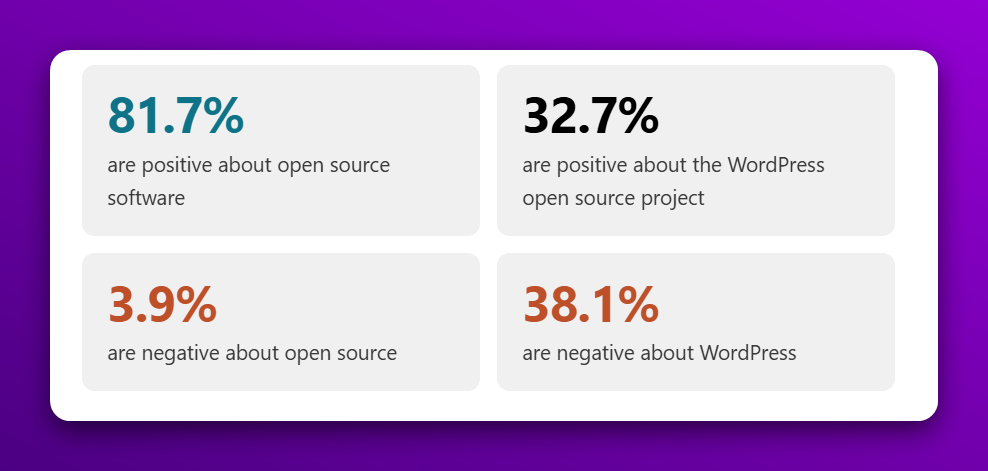
The survey found a notable gap between respondents’ views of open source generally and their views of WordPress. While 81.7% said they were positive about open source software, 32.7% said the same about the WordPress open source project. Half of respondents were positive about open source while neutral or negative about WordPress, with 27.8% positive about open source but negative about WordPress.
Sentiment toward WordPress has also shifted for a large majority of respondents. The survey found that 77.3% felt differently about the project than they had two years earlier. Among those respondents, 95.5% said their feelings had changed for the worse, while 4.5% said they had changed for the better. Overall, 73.8% said they felt more negatively about WordPress than they did 24 months ago.
The report also found that 75.7% of respondents were either negative about or unsure of WordPress’s future. The two groups made up 39.0% and 36.7% of respondents respectively. Despite those views, most had not stopped using WordPress or engaging with the project entirely. Among respondents who were negative about the future, 89.9% still used the software and 73.2% still followed project updates and discussions.
Problems with project leadership or governance were the most commonly reported issue, with 37.4% of respondents saying they had experienced such problems personally and 73.3% saying they had either experienced or witnessed them. This was higher than the other issues included in the question, including conflict or interpersonal tension at 68.2%, dismissive or condescending responses at 67.3%, and hostility or rudeness at 62.4%.

Participation has declined over the past two years as well. The survey found that 38.7% of respondents had reduced their participation in the WordPress community, compared with 15.1% who had increased theirs. Among respondents with at least 10 years in the community, 47.5% had reduced their participation, compared with 30.8% of those with less than 10 years of tenure.
The survey also found a gap between doing community-related contribution work and identifying as a contributor. While 54.3% of respondents said they did some form of contribution work, only 42.0% identified themselves as contributors. Among respondents who did community work only, 48.3% identified as contributors, compared with 86.6% of those who did both community and code work.
The report found that feeling welcome and included was a more important consideration than financial incentives when respondents decided whether to participate. A total of 76.3% rated feeling welcome and included as important or very important, compared with 33.6% for financial incentives.

AI produced another significant divide in the survey. While 71.5% of respondents said they use AI in their work, sentiment toward AI in WordPress was negative overall, with a net score of −33.
Among respondents who use AI in their work, 32.1% were negative about AI in WordPress and 23.7% were positive. Among those who did not use AI, no respondent was positive about AI in WordPress.

Event participation showed another area of reduced engagement. The survey found that 63.8% of respondents had attended an official WordPress event at some point, and 34.2% of those respondents no longer attend. Among those who had stopped attending, 64.9% had also reduced their overall participation.
Those who stopped attending events were still using WordPress at similar rates to current event attendees, but were less likely to participate in community activities. The report found that 94.7% of former event attendees still used WordPress and 86.2% still followed project updates and discussions.
The survey also found continued agreement around several aspects of the WordPress project, with security, web standards, open source values, and the WordPress software itself ranking as important to respondents.

Chris Reynolds, interim president of the WPOCC, said the survey results reflect concerns he has also encountered while attending WordCamp US this year, “ Being at WordCamp US this year, I am seeing a lot of passion for the community and the ecosystem and a lot of concern around the future of WordPress and software development broadly. This echoes what we see in the survey results. I am super excited to share these community insights because it gives the WPOCC and the WordPress community a foundation to grow on.”