


Automattic has soft-launched Spacefast, a publishing and hosting platform for sites and apps built with AI agents. Matt Mullenweg announced the soft launch in a post on X, saying that the team behind Spacefast has been “cooking what I think is the future of WordPress and AI.”
Attention ahead of launch
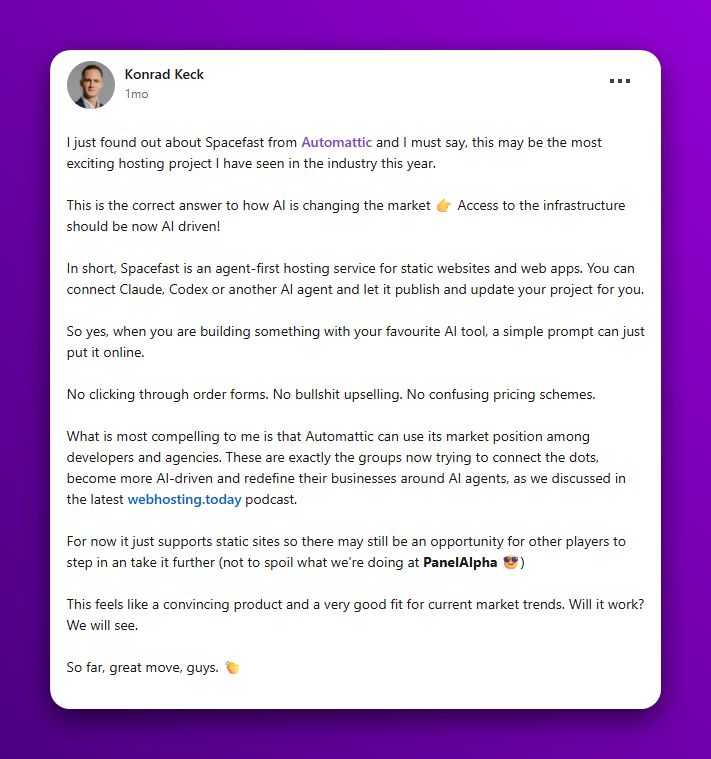
Konrad Keck drew attention to Spacefast in a LinkedIn post a month ago, describing it as an “agent-first hosting service for static websites and web apps”.
He highlighted the ability to publish and update projects through AI agents, calling AI-driven access to hosting infrastructure “the correct answer to how AI is changing the market.” Batuhan İçöz is heading the Spacefast project at Automattic.
Publishing and managing spaces
Users can publish a folder through the Spacefast CLI, while the platform also supports publishing through its HTTP API, MCP server, and dashboard. Users can also ask the agent that built a site to publish it.
Each project on Spacefast is represented by a Space, which gives it a hostname and keeps its published versions organized. Spaces are private by default, with options to invite people, share visitor links, or make a Space public. Publishing an update creates a new version, while the live address points to the version currently being served. Earlier versions can be promoted again or rolled back to without rebuilding the project.
Static output is the default publishing path, but Spacefast also supports dynamic sites too. Its Zero runtime provides a database, HTTP endpoints, live queries, scheduled jobs and storage from a TypeScript application. There is also a Functions runtime for npm-heavy code and framework output such as OpenNext.
The platform supports custom domains, allowing users to connect a domain they own to a Space and make it the site’s primary address.
Accounts and access
Spacefast supports publishing without an account for the first publish. An anonymous Space has a six-hour claim period, during which it can be claimed and moved into a team while keeping its hostname.
Accounts can be created using an email address, or through WordPress.com, Google or GitHub when those providers are enabled. Team invitations can also be used to create an account and join a team. Passwords are optional and can be added after signup, while two-factor authentication can be enabled through an authenticator app with backup codes.
Account settings include profile information, email addresses, security, notifications and privacy controls, along with a Connected apps section that shows apps, agents and CLI connections acting on the account. Users can review active sessions, including the browser, operating system, IP address and session expiry, and can revoke individual sessions or all other sessions.
Services and infrastructure
Spacefast also includes services for applications published on the platform. Transactional email handles messages such as receipts, invitations and magic links, while spam checks screen forms and sign-ups. Web analytics is listed as coming soon and is intended to provide information such as visits, pages and referrers without additional trackers.
Mullenweg described Spacefast’s architecture as “amazing” and said he would like to explore hosting services for companies such as Lovable at a lower cost than they currently pay. He also noted that rising data center and component costs could lead Automattic to limit signups to prioritize WordPress VIP customers.
Batuhan İçöz said Spacefast’s DNS would initially be slower than “the orange cloud” but would still be “#3 fastest in the world.” He added that he was looking forward to rolling out the technology.
Daniel López highlighted Automattic’s server infrastructure as a potential advantage for Spacefast, saying the platform could make good use of it. He also shared that OpenStation’s landing page was already hosted on Spacefast, describing the experience as “a wonderful experience.”
WordPress, database and storage
For applications using Zero, each Space gets its own MySQL database. Developers can declare tables in their application, access the database through the runtime, apply migrations, and use Spacefast’s database tools to inspect data and create backups. Zero also provides storage for visitor uploads and runtime logs.
Every Space is backed by a WordPress installation. Published files are served in front of it, while Zero applications, storage and database features can use that underlying WordPress environment. Users can run WP-CLI commands against a Space and call named WordPress Abilities through short-lived credentials.
Pricing and supported projects
Spacefast has several listed plans. The Free plan is for personal, non-commercial projects and includes 20 Spaces, 20 custom domains and 500 MB of storage. Go costs $5 per team per month and includes $5 of monthly usage credit, while Plus costs $15 per team per month and includes $15 of usage credit and 10 editors.
Prasenjit Sarkar described Spacefast as competing with Here.now and similar services for hosting AI-generated content, adding that “having Automattic’s CDN infrastructure behind it changes the physics of the problem.”
The platform can publish different types of web projects, including single HTML pages, presentations, games and applications built with frameworks such as Next.js, Astro and TanStack Start. It can also publish files such as PDFs, videos and ZIP archives, subject to its file and version limits.